Introduction to Primary Care Paramedics
Primary Care Paramedics (PCPs) are front-line healthcare professionals who provide emergency medical care in the pre-hospital setting. They respond to 911 calls and are trained to manage a wide range of medical and trauma-related emergencies.
PCPs are responsible for assessing patients, providing lifesaving treatments, and safely transporting them to medical facilities. They work closely with other emergency services like fire and police to ensure public safety and quality patient care.
The mission of a PCP is to deliver timely, compassionate, and skilled care to all patients—whether in life-threatening situations or non-urgent calls—across their assigned region.
Emergency SOP
Primary Survey
SSS
The SSS Algorithm stands for “Scene, Safety and Situation”.
Scene: Assess the Scene. This also includes environmental factors such as weather and temperature – which can be done already on the way to the scene.
Safety: Assess with self-protection in mind. Include hazardous goods, traffic, aggressive individuals and PPE in your assessment. After that you also assess the patients safety in the same way.
Situation: How many patients? Which type of forces were involved? Do we need additional units? Check what actually happened. (ex. reported vehicle accident with no crash. internal medicine emergency?)
“First Look”
The “First Look” is supposed to give you a general Impression and first contact with the patient and should be done within the first 15 seconds.
You check for the following visual clues:
- Critical Bleeding?
- Does the patient respond to speech or shaking?
- Can the patient speak normally? (free or blocked airways?)
- Does the patient have a pulse? (weak, strong, fast, slow?)
- How is the skin? (dry or damp? cool or warm? rosy, pale, cyanotic?)
cABCDE
“Treat first what kills first.”
- critical Bleeding =
- Check: For any severe bleeding or large pool of blood indicating a larger Blood loss.
- Intervention: Immediate direct pressure, Pressure bandaging, Tourniquet, Israeli-Bandage
- Airway =
- Check: Is the Airway clear? Is the patient breathing? Is a cervical spine immobilization indicated?
- Interventions: Reclination of the head, Removal of foreign bodies, Airway Management, Recovery Position, Cervical-Spine Immobilization.
- Breathing =
- Check: inspect thorax, cervical veins, auscultate and palpate the thorax, visible cyanotic? SpO2 level?
- Intervention: breathing supporting position, oxygen therapy, assisted or controlled ventilation, decompression
- Circulation =
- Check: pulse? CRT? RR? severe internal or external bleeding? fracture of large bones?
- Intervention: pressurized bandage, tourniquet, volume therapy, pelvic sling
- Disability =
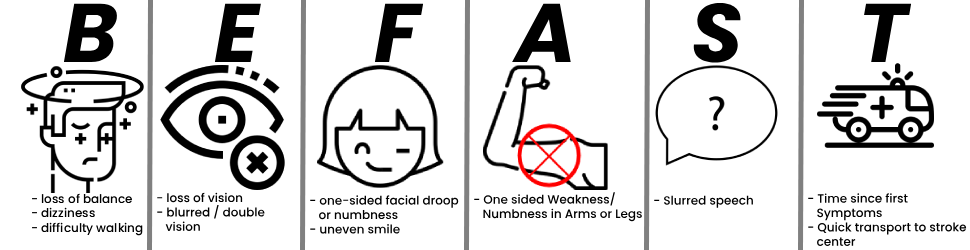
- Check = BE-FAST, Blood Sugar, AVPU, Pupils, Intoxications?
- Intervention = Dextrose/Glucose/Glucagon
- Environment =
- Check = Temp, Surroundings, Weather
- Intervention = Ambulance/ heated environment, blanket